
Technical Insights
Why reinforced PVDF capillary membranes last longer
What the reinforcement does inside a hollow fibre, and where it matters most.
The weak point of a hollow fibre
A capillary membrane is a thin hollow tube. In water with high fouling, aeration and sludge put the fibres under repeated stress, and fibres that are not strong enough can break.
What reinforcement adds
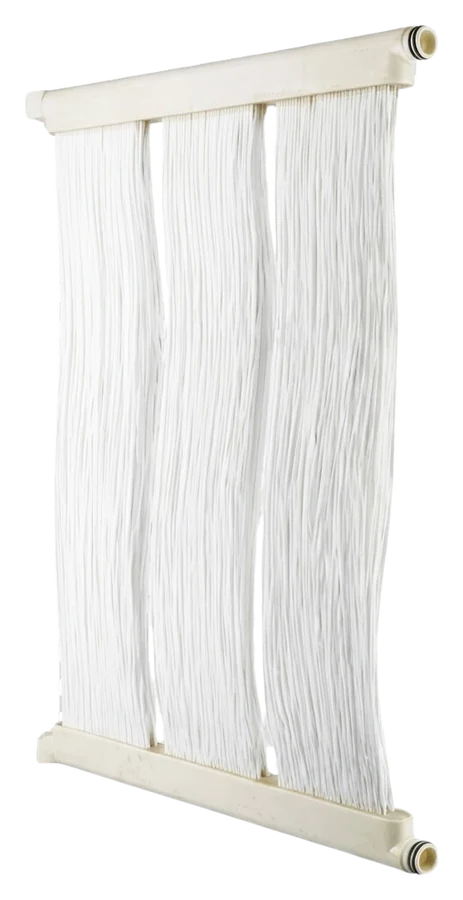
SRP REINFLO and ULTRAFLO 4000 use PVDF membrane bonded to a supporting net tube. The reinforcement adds mechanical strength and tensile modulus, so the fibre withstands the stresses of fouling. That prolongs its working life.
The fibre in numbers
The datasheets give the same fibre dimensions for both reinforced products. These are the figures that matter when you compare them with other capillary membranes.
- Membrane inner and outer diameter: 1.0 mm and 2.6 mm
- Nominal pore size: 0.03 µm
- Potting material: epoxy
- REINFLO operating pH 1–12; ULTRAFLO 4000 operating pH 2–10
- Operating temperature: 5 to 40 °C for both
A steadier pore structure
The datasheets note that the reinforced structure also tends to give a more uniform pore size and less pore swelling. Both help keep filtration efficient and fouling resistance high.
No peeling
Because the membrane is bonded to its supporting tube, it does not detach from it. Peeling is a known failure of coated hollow fibres.
Two products, two duties
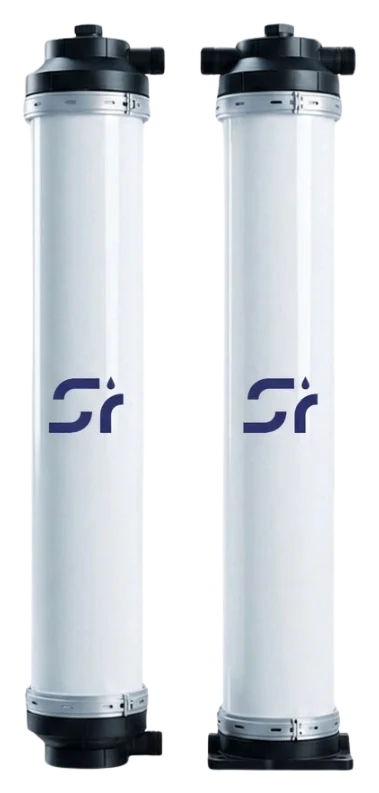
The same reinforced fibre is used in two different ways. REINFLO sits submerged in an MBR tank and filters by gravity or suction, at an operating flux of 10–20 L/m²h on effluent and 20–30 L/m²h on sewage. ULTRAFLO 4000 sits in a housing, runs under pressure and filters at a typical 70–120 L/m²h.
The difference in flux is the difference in duty. An MBR membrane lives in sludge and needs to ride out aeration and fouling. A UF module takes cleaner feed and works harder.
Chemical resistance
SRP membranes are made by c-TIPS (complex thermally induced phase separation), which gives high crystallinity. That brings strong chemical resistance. REINFLO tolerates NaOCl up to 5,000 mg/L, so it can be cleaned with a strong oxidising agent, and its operating pH range is 1–12.
Cleaning it hard, safely
A fibre that is strong and chemically resistant can be cleaned properly. REINFLO tolerates NaOCl up to 5,000 mg/L. ULTRAFLO 4000 is cleaned in place at 1,000–3,000 ppm chlorine and backwashed at 0.2 MPa. Plants that foul quickly benefit most, because a strong clean restores flux that a gentle clean cannot.
When to choose it
Reinforced capillaries suit wastewater with high fouling, variable loads and wide pH swings, and any plant where cleaning needs to be aggressive. For steady, near-neutral feed, a flat sheet such as AEROFLO may do the job at lower energy.
FAQ
Quick answers.
Which SRP products use reinforced PVDF?
SRP REINFLO (submerged MBR) and SRP ULTRAFLO 4000 (pressurised UF).
Does reinforcement change the pore size?
The nominal pore size is 0.03 µm for both products. The datasheets say reinforcement tends to give a more uniform pore size distribution.
Talk to our engineers
Tell us about your water.
Share your application and daily flow. We reply with a suitable membrane or a complete treatment system.
- +91 90565 26208Call or WhatsApp
- crm@srpepl.comQuotes and datasheets
- 70, Industrial Area, Phase - I, Panchkula, Haryana, India - 134113Head office
- Jebel Ali Free Zone, Dubai, U.A.E.International office