
Technical Insights
MBR, UF and RO: what each membrane does
A plain-language guide to where MBR, UF and RO fit in a wastewater treatment and reuse train, what each removes, and how to choose.
Three membranes, three jobs
MBR, UF and RO are often mentioned together, but each does a different job. Choosing the wrong one wastes money, so it helps to know what each one removes and what it needs from the water before it.
The simplest way to see the difference is pore size. Membranes sort what is in the water by size. The tighter the pores, the smaller the thing that gets held back, and the more pressure and care the membrane needs.
MBR: biology plus filtration
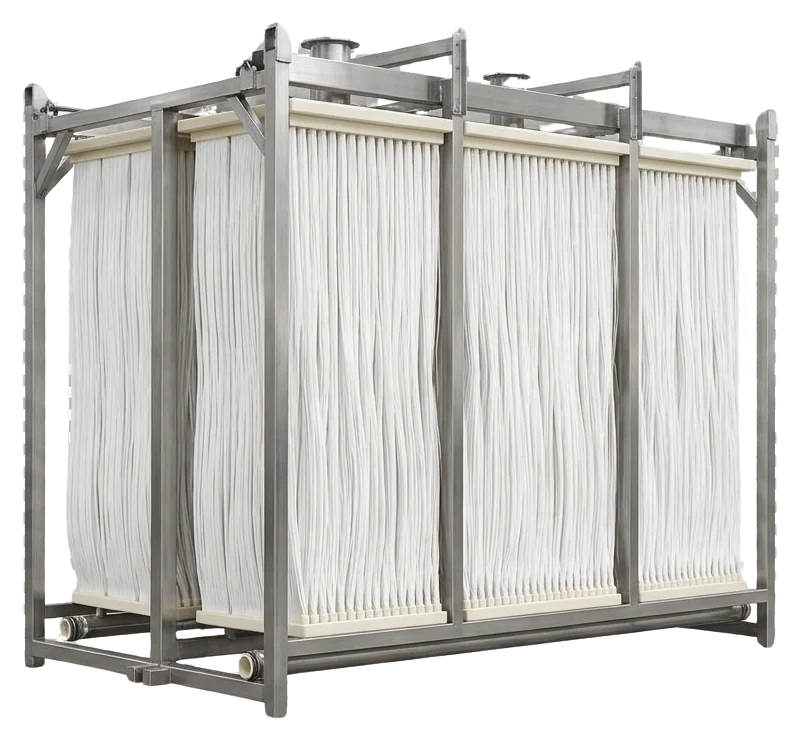
A membrane bioreactor (MBR) replaces the clarifier in an activated sludge plant. Microbes break down the organic load in an aerated tank. A membrane then holds back the sludge and bacteria, so the treated water leaves through the membrane instead of settling out.
Because the membrane, and not gravity, does the separation, treated water quality does not depend on how well the sludge settles. The tank can also hold much more sludge, which means a smaller plant for the same flow. That is why MBR is common where land is tight, where discharge limits are strict, or where the water will be reused.
SRP offers three MBR designs. AEROFLO is a corrugated PVDF flat sheet with a nominal pore size of 0.1 µm. REINFLO is a reinforced PVDF capillary at 0.03 µm, built into cassettes from 40 to 1,750 m². HI-FLO is a PTFE flat sheet at 0.02 µm, in cassettes from 10 to 480 m², and it can run on gravity as well as suction.
What an MBR removes, and what it does not
An MBR gives a very clear, low-solids effluent. It does not remove dissolved salts, so conductivity and total dissolved solids pass through almost unchanged.
- Removes: suspended solids, bacteria, and most of the organic load that the biology has broken down.
- Does not remove: dissolved salts, many colours and some dissolved organics.
- Good for: discharge to a stream, or as clean feed for UF and RO.
UF: a fine physical barrier
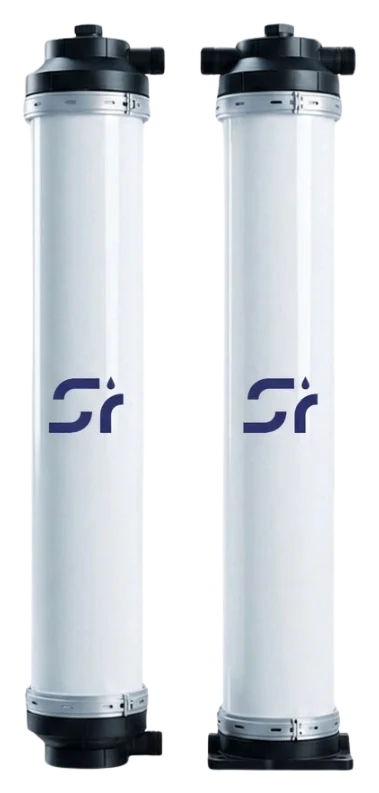
Ultrafiltration (UF) is a physical filter with pores around 0.03 µm. It removes suspended particles, bacteria and most fine particles. It has no biology, so it works on water that is already fairly clean, or on surface and well water.
SRP ULTRAFLO modules are outside-in capillary UF with air scouring. ULTRAFLO 3000 uses PVDF capillaries and ULTRAFLO 4000 uses reinforced PVDF for tougher duty. Typical filtrate flux is 40 to 100 L/m²h for the 3000 series and 70 to 120 L/m²h for the 4000 series.
UF is used in three main places: to polish MBR or sewage effluent for reuse, to treat river or well water for drinking, and to protect RO elements. UF in front of RO keeps the RO feed at a low silt density, which extends the life of the elements.
RO: removing dissolved salts
Reverse osmosis (RO) pushes water through a very tight membrane at high pressure. Water passes, and dissolved salts and small molecules stay behind. It is the step that makes water reusable in many processes, and the step that makes seawater and brackish water drinkable.
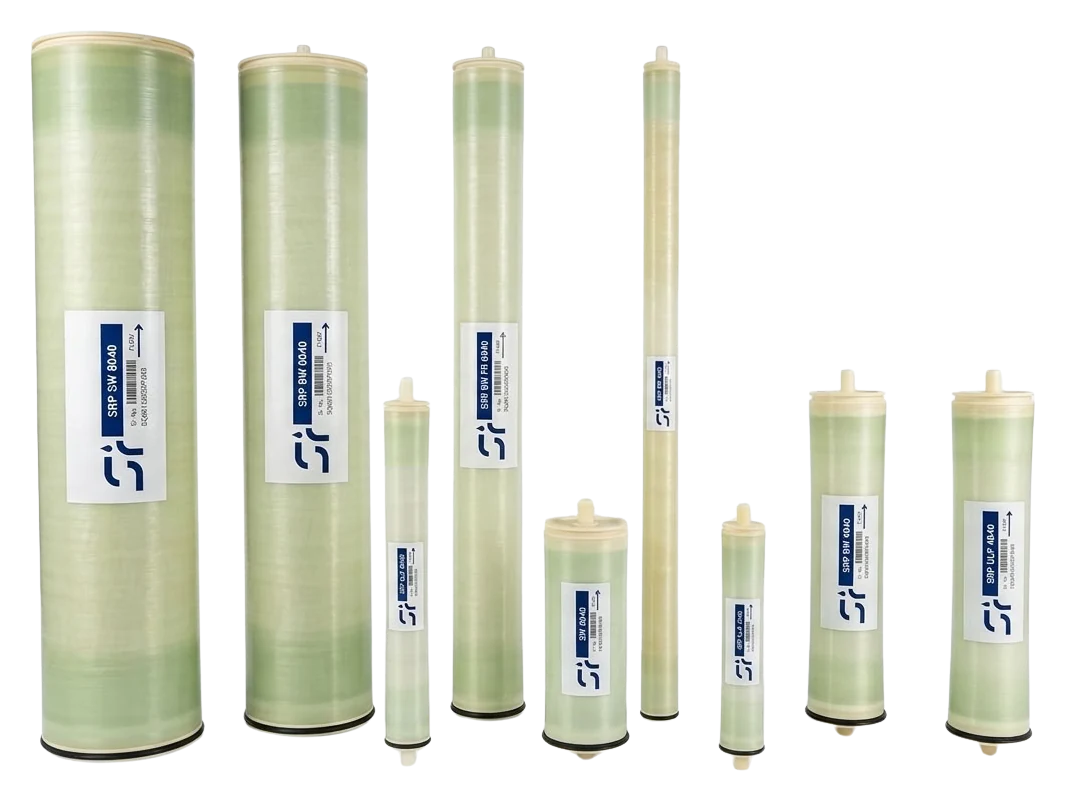
SRP RO elements are spiral-wound polyamide thin-film composite. BW elements treat brackish water, ULP elements work at lower pressure, and SW elements treat seawater. Stabilised salt rejection runs from 99.2 to 99.6 percent for brackish elements and 99.85 percent for the SW 8040.
RO is demanding about its feed. SRP RO elements are designed for a silt density index (SDI) of 5 or lower and tolerate less than 0.1 ppm of free chlorine, so the water needs UF or MBR and dechlorination before it reaches them. Part of the feed leaves as a concentrated reject stream that needs handling.
How they fit together
For industrial reuse, a typical order is screening, MBR, UF where needed, then RO. The RO reject is concentrated, so DTRO (disc-tube RO) and zero-liquid discharge can follow when the reject cannot be discharged.
Not every plant needs every step. The right train depends on your feed water, your discharge limit and what you want to do with the water.
Which one do I need?
Start from what you want at the end, and work backwards.
- Meet a discharge limit for organics and solids: MBR alone is often enough.
- Reuse the water for cooling, washing or irrigation: MBR, then UF if needed.
- Reuse where dissolved salts matter, such as boilers or process water: MBR or UF, then RO.
- Seawater or brackish source: UF pre-treatment, then RO.
- RO reject you cannot discharge: DTRO and zero-liquid discharge.
What to do next
Tell us your application and flow, and we will suggest where each membrane belongs. You can also try the membrane finder for a first selection. If you need the whole plant, our parent company SR Paryavaran designs and builds complete treatment systems around SRP membranes.
FAQ
Quick answers.
Do I always need all three?
No. Many plants use an MBR alone when treated water only has to meet discharge standards. UF and RO are added when you want to reuse the water, and dissolved salts must come down.
Can RO treat raw wastewater directly?
Not well. RO needs clean feed, because suspended solids and organics foul the elements. An MBR or UF stage normally protects it.
What is the difference between UF and MBR?
An MBR is a biological process with a membrane in it. Microbes treat the water and the membrane separates the sludge. UF has no biology. It is a physical filter used on water that has already been treated or comes from a cleaner source.
Why does RO need UF or MBR first?
Suspended solids and organics foul RO elements quickly and shorten their life. UF or MBR removes them first. SRP RO elements are designed for feed with an SDI of 5 or lower.
Talk to our engineers
Tell us about your water.
Share your application and daily flow. We reply with a suitable membrane or a complete treatment system.
- +91 90565 26208Call or WhatsApp
- crm@srpepl.comQuotes and datasheets
- 70, Industrial Area, Phase - I, Panchkula, Haryana, India - 134113Head office
- Jebel Ali Free Zone, Dubai, U.A.E.International office